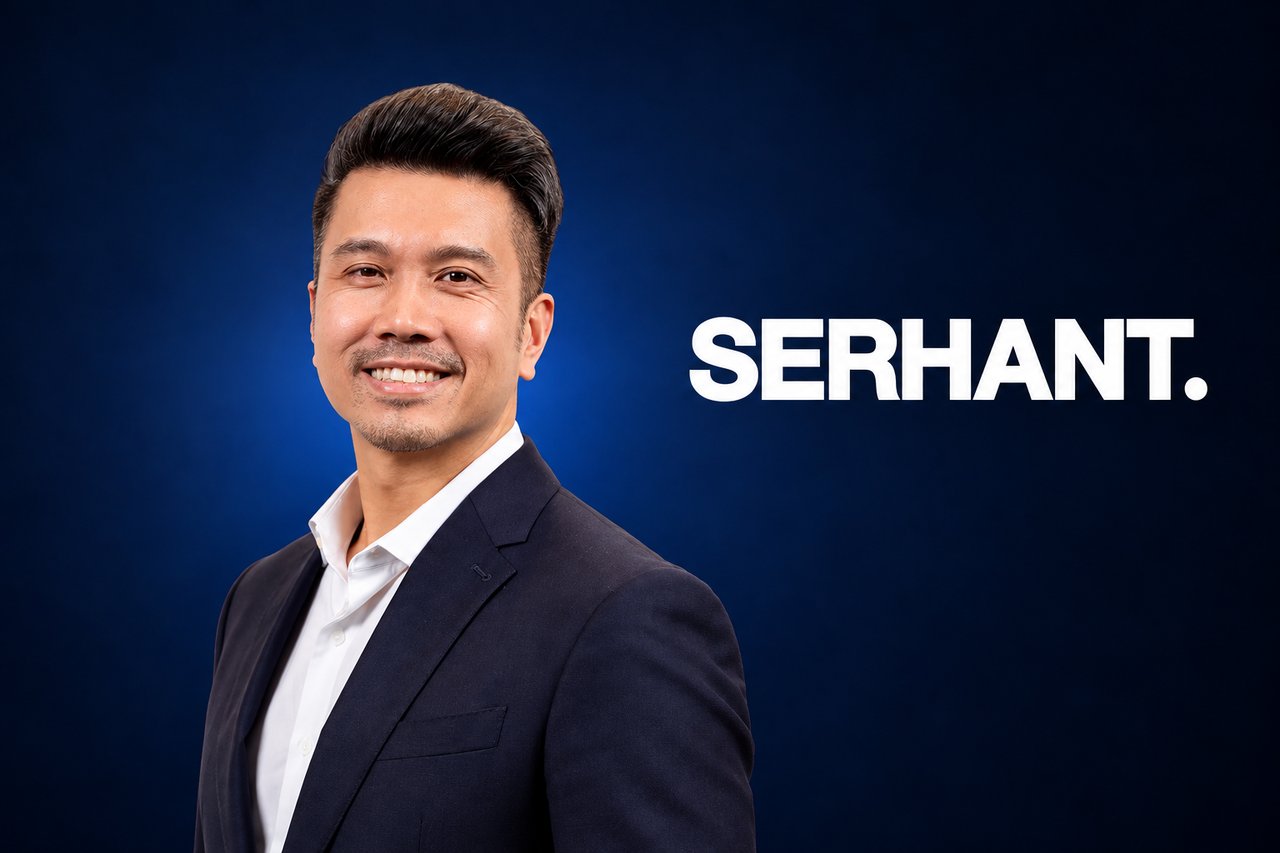
SERHANT.'s chief technology officer spent 25 years at Microsoft, Amazon, and Akoya, building systems used by millions. Now he's creating the infrastructure to connect agents, their customers, vendors, and fundamentally transform how homes are bought and sold from the inside out.
Greg Chan has spent his career building technology that millions of people use without ever thinking about it. The best systems he built shared two distinctive qualities: they were invisible, and they worked seamlessly. Now, as Chief Technology Officer at SERHANT., he's harnessing that experience to transform real estate, an industry that moves trillions of dollars a year yet operates as if Ask Jeeves were still around. For Greg, that yawning gap between the industry’s scale and its level of technology is a tantalizing opportunity. His answer is S.MPLE 2.0, the next generation of SERHANT.'s proprietary AI platform, which executes end-to-end real estate workflows from a single instruction.
A Career Built on Tech's Biggest Stages
Greg's résumé reads like a tour through the systems that run modern life. He started at Microsoft, helping deliver the core Office products that became the world’s default tools for writing, data analysis, and presentations. He then spent a decade at Amazon in leadership roles across Amazon Payments and the Prime delivery and shopping experience, launching now-ubiquitous global payment products and building platforms where reliability was the beginning, middle, and end of the entire job.
After Amazon, Greg served as VP of Engineering at a fintech and B2B startup, scaling its product, technology, and team. He then became Chief Technology Officer at Akoya, an open finance company built to give consumers real control over their financial data. Under his leadership, Akoya scaled its financial data access network and launched a new open finance solution for major financial institutions.
Serving the Individual to Drive Widespread Change
Akoya was where Greg's philosophy came into focus. For years, using a financial app meant handing over your bank login and hoping for the best, with your data pulled in the background and no easy way to see or stop it. Akoya built on explicit permission, so customers could see exactly what they're sharing and revoke it whenever they choose. The real product wasn't the data pipe. It was giving people authority over their own financial lives.
Recognizing that same instinct was what drew Greg to SERHANT. in the first place. Where Akoya put power back in the hands of the consumer, SERHANT. is putting it in the hands of the agent. The mission that now drives him is straightforward: build tools that make the individual agent more capable, more efficient, and more free to do the most important aspects of the job. That’s where S.MPLE comes in.
S.MPLE 2.0: Real Estate’s First AI Chief of Staff
S.MPLE is an AI-native platform built to take the operational weight off agents so they can spend their time where it matters, with clients. Real estate agents lose enormous portions of their day to administrative work: coordinating transactions, chasing paperwork, managing listings, following up. S.MPLE absorbs that load. And if S.MPLE 1.0 was a task machine, S.MPLE 2.0 is an outcome engine.
For years, real estate technology has followed one pattern: give the agent another tool, another login, another dashboard to operate. The issue? Too many tools that were too disparate. Agents lost so much time learning every new thing that the tools became a hindrance rather than a help.
Instead of handing agents more software, S.MPLE 2.0 does the work itself, orchestrating dozens of specialized AI agents and tools to execute real estate jobs across an agent's business, from comparative market analyses and listing presentations to marketing campaigns, transaction coordination, financial reporting, compliance, and client follow-up.
All the agent has to do is describe an outcome to its AI chief of staff, Dot. Ask Dot to prepare for a listing appointment, and Dot will research the market, pull comparables, analyze pricing, build the presentation, apply the agent's branding, and review every page against applicable compliance rules. Work that once meant bouncing between systems, departments, and separate requests now happens from one instruction.
Shaped by Greg’s Proven Playbook
Under the hood, S.MPLE 2.0 reflects the principles Greg has carried throughout his career. Its anticipation engine runs on durable execution, so longer-running workflows keep going in the background and resume the moment new information arrives—reflecting the same “can't-go-down" mindset he brought to payments at Amazon. Compliance isn't a separate check after the fact: S.MPLE reviews its own work against the major regulatory regimes, including the Fair Housing Act, RESPA, and the Sherman Act, as part of doing the job. And the platform is trained on SERHANT.'s own deals, coaching, and Sell It education platform, so it reflects how top agents actually close in the real world, not how a software company imagines they do.
A Company Built to Move
SERHANT. is growing 100% year over year, entering new markets every month, and now spans more than 2,000 agents across 20 states nationwide. For a technologist who spent 25 years building for the largest companies in the world, it's the chance to build something that makes a measurable difference in one person's day, thousands of times over.
About Greg Chan
Greg Chan is Chief Technology Officer of SERHANT., the AI-native real estate company, where he leads development of S.MPLE, the company's proprietary AI platform, including the launch of S.MPLE 2.0. He brings 25 years of technology leadership across Microsoft, Amazon, and fintech and enterprise SaaS startups. At Microsoft he helped deliver core Office products. During a decade at Amazon he held leadership roles across Amazon Payments and the Prime delivery and shopping experience, launching global payment products and building high-scale platforms. He later served as VP of Engineering at a fintech and B2B startup, and most recently as Chief Technology Officer at Akoya, where he scaled its financial data access network and launched a new open finance solution for major financial institutions. He is a board member of the Center for Disaster Philanthropy and holds an MBA from the MIT Sloan School of Management.